
Retirement Party Invitations
Cards and videos for superannuation functions, office farewells and family celebrations, with wording, timing and etiquette guides for each kind of send-off.
Looking for something else? For farewell quotes, retirement speeches and things to write in a leaving card, see our farewell quotes and speeches guide. For goodbye and bon voyage card designs, see send-off and goodbye cards. This page is about planning and wording the invitation itself.








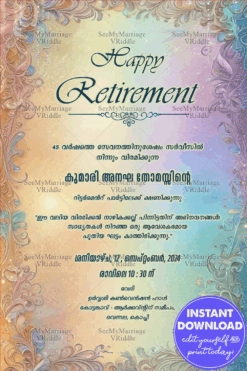
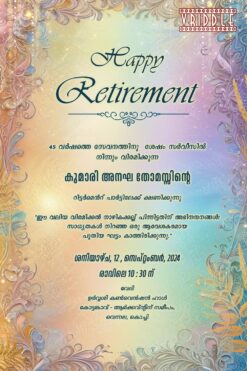













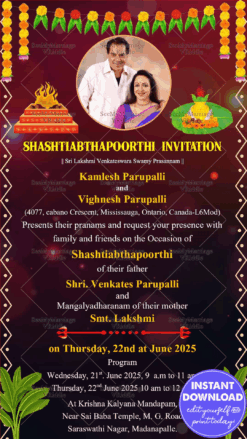


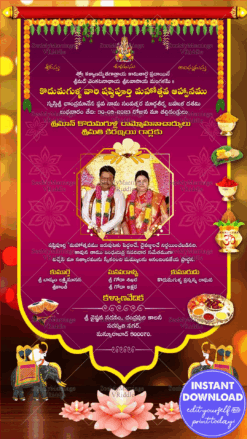
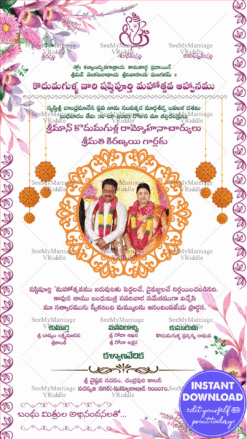



Who is hosting, and why it changes everything
This is the first thing to settle, because it determines the tone, the wording, the guest list and even whose name the invitation goes out under. Three quite different events all get called a “retirement party”.
The organisation is hosting
The invitation goes to colleagues and the retiree is the guest of honour, not the host. Tone is respectful and formal, and the retiree’s designation and years of service normally appear. In Indian government and public-sector organisations this is typically a superannuation function, with speeches and the presentation of a shawl or memento.
The family is hosting
The invitation goes to relatives and family friends, and reads far closer to a celebration than a workplace event. Years of service matter less and the person matters more. Many Indian families mark the occasion with a puja or a temple visit in the morning and a lunch or dinner afterwards.
Colleagues are hosting informally
A team-organised send-off: dinner, drinks, a restaurant booking. Casual tone, often no mention of designation at all, and usually a much shorter guest list than an official function.
Getting this wrong is the most common mistake. A formal superannuation-style card sent for what was meant to be a relaxed team dinner sets entirely the wrong expectation, and people arrive dressed for a different evening. Decide which of the three you are actually hosting before you choose a design.
Retirement, farewell or superannuation
These three words get used interchangeably in conversation, but guests read them literally on an invitation, and choosing the wrong one causes real confusion.
- Retirement means the person is leaving working life. It is permanent, it is a genuine milestone, and it carries the weight of a whole career.
- Superannuation is commonly used in Indian government, public-sector and banking organisations for retirement on reaching the prescribed age. It carries a formal, institutional tone and usually implies an official function with a set programme.
- Farewell means someone is leaving this organisation, but not necessarily working life. A farewell for a colleague joining another company is a completely different event from a retirement.
If the person is transferring, resigning or moving to another role, use farewell. Reserve retirement for the end of a career. Calling a job change a retirement is an awkward mistake to make in print, and it is one that circulates: the invitation gets forwarded, and the error travels with it.
Timing and practical planning
Retirement functions have a fixed anchor most events do not: the retiree’s last working day. Everything else plans around it.
- Send two to three weeks ahead for a workplace function, and three to four where relatives are travelling or the date falls near a holiday period.
- Confirm the date with the retiree first. Surprise retirement parties go wrong more often than surprise birthdays: the retiree usually has exit formalities, handover meetings, or their own family plans already arranged for that week.
- Official functions usually fall on the last working day, which may not be convenient for anyone. If you want a well-attended evening event, consider holding the social celebration separately from the official function.
- Friday evening attracts the best turnout for an informal send-off. Mid-week dinners lose people to commutes and family commitments.
- Tell speakers in advance. Anyone expected to say a few words should know before they arrive, not thirty seconds beforehand.
- Check whether the retiree wants a large event at all. Some people genuinely prefer a quiet lunch with their immediate team. Asking costs nothing.
What to include in the invitation
A retirement invitation carries more practical information than most people expect, because the guest list usually spans colleagues, family and old friends who do not know each other.
- Whose retirement it is, with full name, and designation where it is a workplace event.
- Years of service or the date range, if the tone is formal. “1990 to 2026” reads well on a card and does a lot of work in a single line.
- Date, time and venue, with a landmark. Colleagues may know the office; visiting family will not.
- Who is hosting: the department, the family, or a group of colleagues. This tells guests what kind of evening to expect.
- Dress code, if there is one. “Formal” and “come as you are” produce very different evenings, and people dislike being the only one who guessed wrong.
- Gift guidance, covered in its own section below.
- RSVP contact and deadline, particularly where catering needs numbers.
- A memory request, if you want one: asking guests to bring a photograph or a short written note produces a keepsake that outlasts the evening. This has to be on the invitation, because nobody arranges it on the day, and it needs a deadline several days before the event rather than on the morning itself.
If you are also asking colleagues to speak, tell them when you send the invitation, not on the night. For help with what they might say, see our farewell quotes and speeches guide.
Invitation wording
Adapt these rather than using them as they stand. The right tone depends entirely on which of the three hosting situations you are in.
Formal, organisation hosting
The Department of [Name] requests the pleasure of your company at a function to felicitate [Name], [Designation], on the occasion of superannuation after [N] years of distinguished service. [Day, date] at [time], [venue]. High tea will follow the programme.
Formal, with gratitude
With deep gratitude for [N] years of dedicated service, we invite you to join us in wishing [Name] a happy, healthy and well-earned retirement. [Day, date] at [time], [venue].
Family hosting
After [N] years of early mornings and long commutes, our father is finally retiring. Please join our family in celebrating this milestone with him. [Day, date] at [time], [venue]. Lunch will be served.
Warm and informal
No more alarms. No more inbox. No more Monday meetings. Come and send [Name] off properly. [Day, date] at [time], [venue].
Team send-off
[Name] is hanging up the lanyard after [N] years with us. Dinner, drinks and far too many stories. [Day, date] at [time], [venue]. RSVP to [contact] by [date].Gifts and contributions
This is where retirement invitations most often create confusion, because guests have no default expectation to fall back on.
If contributions are being collected towards a shared gift, say so on the invitation and name a single point of contact with an amount or a range. Guests who are not told will either give nothing and feel awkward, or give individually and duplicate what the group has already bought.
If gifts are genuinely not expected, say that explicitly. “No gifts please, your presence is the gift” reads as a formality that many guests will disregard; “we are not exchanging gifts at this event” is clearer. Silence is almost always read as “gifts expected”.
For official superannuation functions, the memento or shawl presentation is usually handled by the organisation, and individual gifts from colleagues are unusual. Where the family hosts separately, personal gifts are more common. If both events are happening, it helps to say which is which on each invitation.
Card or video invitation
Both work. The decision usually comes down to the guest list rather than the occasion.
Choose a card invitation if
The invitation is going out through official channels or email, it needs to be printed for a noticeboard, or the guest list includes people who will read it once and want the details visible at a glance. Formal superannuation functions almost always use cards.
Choose a video invitation if
The event is informal, the guest list is on WhatsApp, or you want to include photographs from across the retiree’s career. Video invitations get forwarded more, which helps reach former colleagues who have already left the organisation and are not on the current mailing list.
Related invitation ranges: corporate event invitations, anniversary invitations, and social party invitations.
Frequently asked questions
How far in advance should retirement invitations be sent?
Two to three weeks for a workplace function, and three to four where relatives are travelling or the date falls near a holiday period. Official superannuation functions are often fixed to the last working day, so the date may be set well in advance even if the invitation goes out later.
What is the difference between a retirement and a farewell?
Retirement means leaving working life permanently. A farewell means leaving this particular organisation, which may be a resignation, a transfer or a move to another company. Using “retirement” for a job change is a common and awkward error, and the invitation usually gets forwarded with the mistake intact.
Should the invitation mention gifts?
Only if there is something guests need to know: a shared collection with a contact and an amount, or an explicit statement that gifts are not being exchanged. Saying nothing is generally read as “gifts expected”, which is rarely what the host intends.
Can I use these designs for a farewell rather than a retirement?
Yes. Several designs suit both, and all text is editable. Change the wording so the event is described accurately, and avoid describing a job change as a retirement.
Should we hold a surprise retirement party?
Generally not. Retirees usually have exit formalities, handover meetings and their own family arrangements in their final week, and a surprise event competes with all of it. Confirming the date with the retiree also lets them tell you who they actually want invited, including former colleagues who have already left.
Can the invitation be in a regional language?
Yes. All designs are text-editable, and several in this range are built specifically with Tamil and North Indian wording for traditional retirement functions.
Are these invitations free?
Some retirement designs are free to customise and download; several premium card and video designs are paid. The price is shown on each design page before you start customising.